The Paradox Nobody Talks About
You take a stimulant to calm down. Sounds absurd until you understand the neuroscience. Caffeine in an ADHD brain doesn't do what it does in a neurotypical one.
About 50% of adults with ADHD report using caffeine as a self-medication strategy (Addicott, 2014, Psychopharmacology). Not because they read it somewhere. Because they accidentally discovered that their 3pm coffee made them feel... normal.
How Caffeine Actually Works in Your Brain
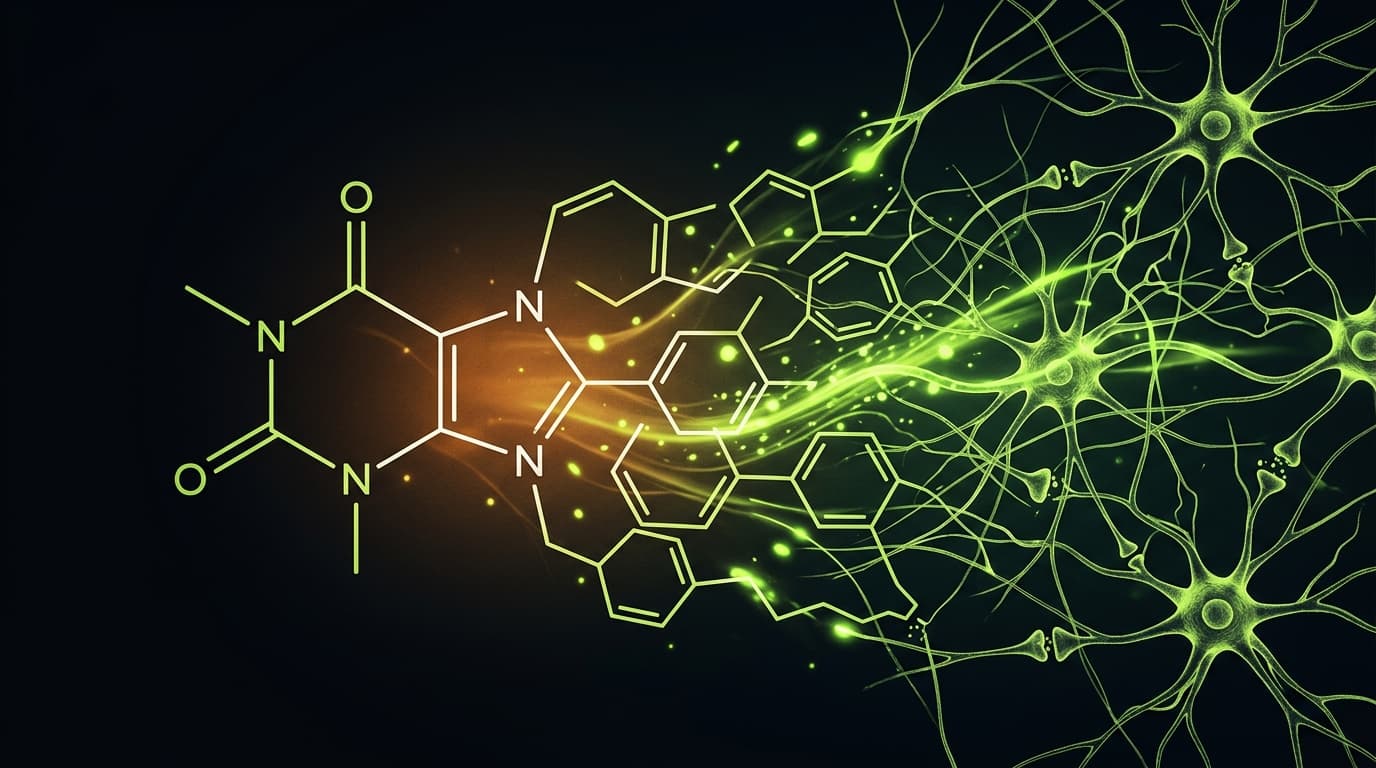
Caffeine is an adenosine receptor antagonist. Adenosine builds up throughout the day and makes you sleepy. Caffeine blocks those receptors, keeping you alert.
But here's what matters for ADHD: blocking adenosine receptors has a downstream effect on dopamine. When adenosine can't bind, dopamine transmission increases in the prefrontal cortex (Ferré, 2008, Journal of Neurochemistry). The same region that's chronically underactivated in ADHD.
This is why caffeine can produce a calming, focusing effect in ADHD brains. It's not stimulating you up. It's bringing your baseline dopamine deficiency in ADHD closer to where it should be.
What the Research Actually Shows
A meta-analysis of 14 studies found that caffeine improved attention and reduced impulsivity in ADHD populations at moderate doses (Ioannidis et al., 2020, Nutritional Neuroscience). The effect size was modest compared to prescription stimulants, but statistically significant.
Animal models are even more compelling. Pandolfo et al. (2013, Neuroscience) found that caffeine normalized dopamine transporter density in ADHD-model rats. The caffeine literally changed the structure of dopamine pathways.
But dosing matters enormously. Below 100mg, effects are minimal. Between 200-400mg, most studies show cognitive benefits. Above 400mg, anxiety spikes and any focus gains disappear (Temple, 2019, Frontiers in Psychiatry).
The Tolerance Problem
Here's where caffeine fails as a long-term ADHD strategy. Adenosine receptors upregulate within 7-12 days of consistent use (Fredholm et al., 1999, Pharmacological Reviews). Your brain grows more receptors to compensate.
This means your morning coffee stops producing cognitive benefits and starts preventing withdrawal. You're no longer getting focus. You're preventing a headache.
The people who report caffeine "working for their ADHD" long-term are typically cycling: heavy use for 3-5 days, then a break. The break resets tolerance. The problem? Those off-days are brutal for ADHD activation struggles.
Caffeine vs. Actual ADHD Treatment
Let's be clear about the magnitude difference. Methylphenidate increases dopamine by 200-400% in the prefrontal cortex (Volkow et al., 2001, American Journal of Psychiatry). Caffeine increases it by roughly 20-30%.
Caffeine is not a replacement for proper ADHD management. It's a supplement. A tool in the toolbox. Not the toolbox.
The most effective approach combines targeted interventions. Medication for baseline dopamine. Environmental design for task initiation. And sensory tools like focus music for ADHD that provide sustained stimulation without tolerance buildup.
The Timing Protocol That Actually Works
Based on the research, here's what the evidence supports for ADHD caffeine use:
Delay your first caffeine 90-120 minutes after waking. Cortisol is already elevating dopamine in the morning. Adding caffeine on top creates an anxiety spike, not a focus boost (Lovallo et al., 2005, Psychosomatic Medicine).
Keep individual doses at 100-200mg (one standard coffee). Use strategically for specific work blocks rather than continuously throughout the day. Take 2-3 caffeine-free days per week to prevent full tolerance.
The Better Long-Term Strategy
Caffeine is training wheels. It works, but it has a ceiling. And that ceiling is lower than you'd like.
The ADHD brain needs consistent dopaminergic stimulation that doesn't build tolerance. This is precisely why amplitude-modulated focus music works differently than caffeine. The modulation patterns change constantly (preventing habituation) while maintaining the neural stimulation your prefrontal cortex needs.
FocusFast uses three independent oscillators at 37, 53, and 71-second periods specifically to prevent the same tolerance problem that makes caffeine unreliable. Your brain can't adapt to a pattern that never repeats.
FAQ
Does caffeine help people with ADHD focus?
Yes, research shows caffeine can modestly improve attention and reduce impulsivity in ADHD brains by increasing dopamine in the prefrontal cortex. However, the effect is significantly weaker than prescription stimulants and builds tolerance within 7-12 days of consistent use.
Why does coffee calm me down if I have ADHD?
Caffeine blocks adenosine receptors, which increases dopamine transmission in the prefrontal cortex. Since ADHD brains have chronically low dopamine activity in that region, caffeine brings you closer to a normal baseline rather than overstimulating you.
How much caffeine is safe for someone with ADHD?
Studies show cognitive benefits between 200-400mg daily, with individual doses of 100-200mg being optimal. Above 400mg, anxiety increases and focus benefits disappear entirely.
Can caffeine replace ADHD medication?
No. Prescription stimulants increase prefrontal dopamine by 200-400%, while caffeine only provides a 20-30% boost. Caffeine works best as one tool among several, not as a standalone treatment.