For two decades, focus music meant one of two things: lo-fi beats or binaural beats. The first works by accident. The second barely works at all.
Then a different technique started showing up in functional music apps. It is called amplitude modulation, and it produces measurable brainwave changes that binaural beats often fail to deliver.
If you have ever wondered why some focus tracks feel sharp and useful while others feel like sonic wallpaper, the answer usually lives in this one engineering choice.
What Amplitude Modulation Actually Is
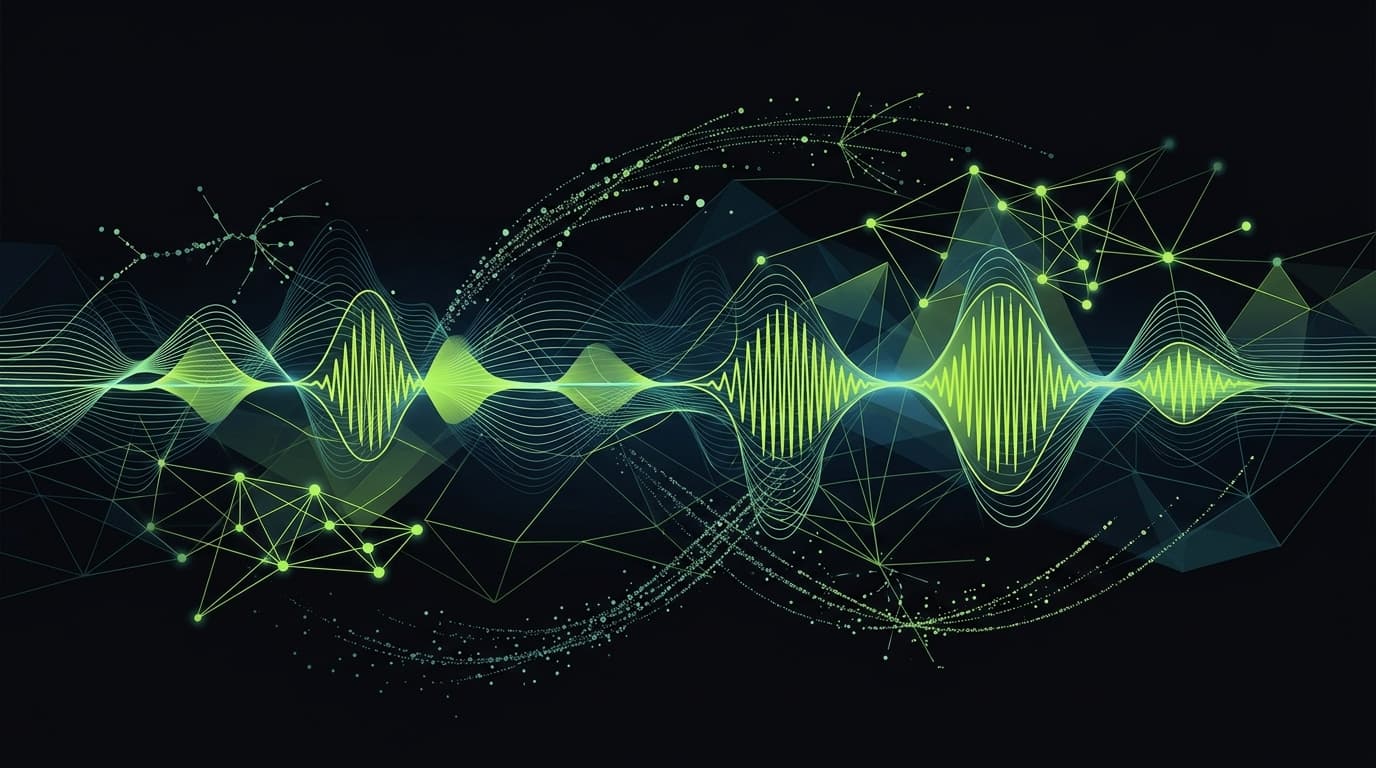
Amplitude modulation (AM) means rhythmically pulsing the loudness of a sound at a specific frequency. A tone playing at 440 Hz gets its volume swelled up and down 14 times per second. The carrier sound is the music. The modulation rate is the brainwave target.
This is not subtle EQ tweaking. The pulses are present in the waveform and can be measured in the air. Your auditory cortex tracks them automatically, a response neuroscientists call the auditory steady-state response (ASSR).
The ASSR is one of the most reliable brain responses in all of neuroscience. Hit the ear with a modulated tone and EEG electrodes show a phase-locked signal at the exact modulation rate (Picton et al., 2003, International Journal of Audiology).
How It Differs From Binaural Beats
Binaural beats require headphones, send a different frequency to each ear, and rely on the brainstem to generate a perceived beat. The effect is acoustically imaginary. It only exists inside your head.
Amplitude modulation is acoustically real. It works through speakers. It works with one ear plugged. And it produces a stronger cortical entrainment response than binaural beats in head-to-head EEG comparisons (Schwarz and Taylor, 2005, Clinical Neurophysiology).
Why the Brain Locks Onto AM
The auditory system evolved to track amplitude envelopes. Speech is essentially an amplitude-modulated signal. Footsteps, animal calls, and threats in the environment all have rhythmic loudness contours.
Your cortex is wired to follow these contours with millisecond precision. When you feed it a steady modulation rate, neural populations begin firing in synchrony with that rhythm. This is neural entrainment in its most direct form.
Research from the McGill Auditory Research Lab has shown that 40 Hz amplitude modulation produces gamma-band entrainment associated with sustained attention and cognitive binding (Ross et al., 2005, Journal of Neuroscience).
The Frequency Bands That Matter
Different modulation rates target different brain states:
- 14 to 18 Hz (beta): Sustained focus and active problem solving
- 40 Hz (gamma): Cognitive binding, attention, working memory
- 8 to 12 Hz (alpha): Relaxed alertness, creative flow
- 4 to 7 Hz (theta): Deep relaxation and meditative states
A focus track might use 16 Hz modulation for a work session and 10 Hz for a creative reset. The carrier music is musical for the human ear. The modulation is functional for the brain.
The Evidence Stack
The case for AM as a focus tool rests on three separate research lines.
EEG entrainment studies. ASSR responses to modulated audio are measurable within seconds and grow over minutes of exposure (Galambos et al., 1981, Proceedings of the National Academy of Sciences). The brain reliably synchronizes to the rhythm.
Behavioral attention studies. A 2021 fMRI study found that listening to amplitude-modulated functional music increased sustained attention performance and modulated activity in attention-related brain networks compared to silence or unmodulated music (Woods et al., 2021, Communications Biology).
ADHD-specific work. Adults with ADHD showed larger productivity gains from modulated focus audio than neurotypical controls, consistent with the idea that ADHD brains benefit most from external rhythmic stimulation (Woods et al., 2021, Communications Biology).
Why Binaural Beats Keep Losing
A meta-analysis covering 22 binaural beat studies concluded that effects on attention and cognition are inconsistent and often small (Garcia-Argibay et al., 2019, Psychological Research).
We covered the full breakdown in our binaural beats for ADHD review of 12 studies. The short version: binaural beats produce a faint brainstem response that rarely propagates to the cortex. AM produces a robust cortical response by design.
How Modern Focus Apps Use AM
The functional music apps that actually move the needle (Brain.fm, Endel, and a handful of newer entrants) all rely on amplitude modulation as their core entrainment mechanism.
The audio is composed normally as music. Then the engineers apply rhythmic gain modulation at the target frequency. The result is music that sounds pleasant but carries an embedded brainwave signal.
FocusFast uses amplitude modulation at multiple band centers because attention is not one thing. Sustained reading benefits from different modulation than creative writing or coding.
What to Look For in a Track
If you are evaluating focus music, listen for a subtle pulsing quality in the sound. Not a beat in the musical sense. A textural shimmer that repeats many times per second.
Tracks without it might still be pleasant background audio. They will not entrain anything.
For our full breakdown of which apps actually implement this correctly, see our honest review of Brain.fm after reverse-engineering its audio.
The Limits Worth Knowing
AM is not magic. Three honest caveats apply.
First, entrainment effects are real but modest. A typical study reports productivity gains in the 10 to 25 percent range, not 200 percent.
Second, the carrier matters. Modulated white noise entrains the brain but is unpleasant to work to. Modulated music that you actively dislike will hurt focus through annoyance even if the entrainment works.
Third, individual variation is large. Some people show strong ASSR responses. Others show weak ones. The technology has a ceiling determined by your auditory neurobiology.
Comparison: AM vs Other Focus Audio
- Amplitude modulation: Real cortical entrainment, works on speakers, modest but measurable productivity gains
- Binaural beats: Headphones required, weak cortical response, inconsistent behavioral effects
- Lo-fi music: Pleasant, no entrainment, works through mood regulation only
- Brown noise: Masks distractions, no entrainment, helpful for sensory-sensitive ADHD
- Silence: Best for pure deep work if your environment allows it
For the full landscape, our neural entrainment music guide covers every major technique with its evidence base.
FAQ
Does amplitude modulation focus music require headphones?
No. Unlike binaural beats, AM is an acoustically real signal that travels through speakers. Headphones can improve the experience by blocking outside noise, but the entrainment effect does not depend on them.
What modulation frequency is best for focus?
Beta-band modulation between 14 and 18 Hz is associated with sustained focus and active cognitive work. Gamma-band modulation at 40 Hz targets attention and working memory. The right frequency depends on the task.
Can amplitude modulation cause side effects?
For most listeners, no. People with photosensitive or audiogenic epilepsy should consult a clinician before using any entrainment audio, as rhythmic sensory input is the same class of stimulus that can trigger seizures in susceptible individuals.
How long does it take to feel the effect?
EEG entrainment begins within seconds of exposure. Subjective focus effects typically take 5 to 15 minutes as your attention settles and the cortical synchronization builds.
Is amplitude modulation the same as binaural beats?
No. Binaural beats use a frequency difference between the two ears and create a perceived beat inside the brain. Amplitude modulation pulses the loudness of a sound in physical air and produces a much stronger cortical response.
The Bottom Line
Amplitude modulation is the boring engineering choice that explains why some focus music actually works while most of it does not.
It is not a trick. It is not pseudoscience. It is the same auditory steady-state response that audiologists have measured in clinics for 40 years, repurposed for cognitive performance.
If you want focus music built on this principle, try FocusFast. The science is in the waveform, not the marketing.